
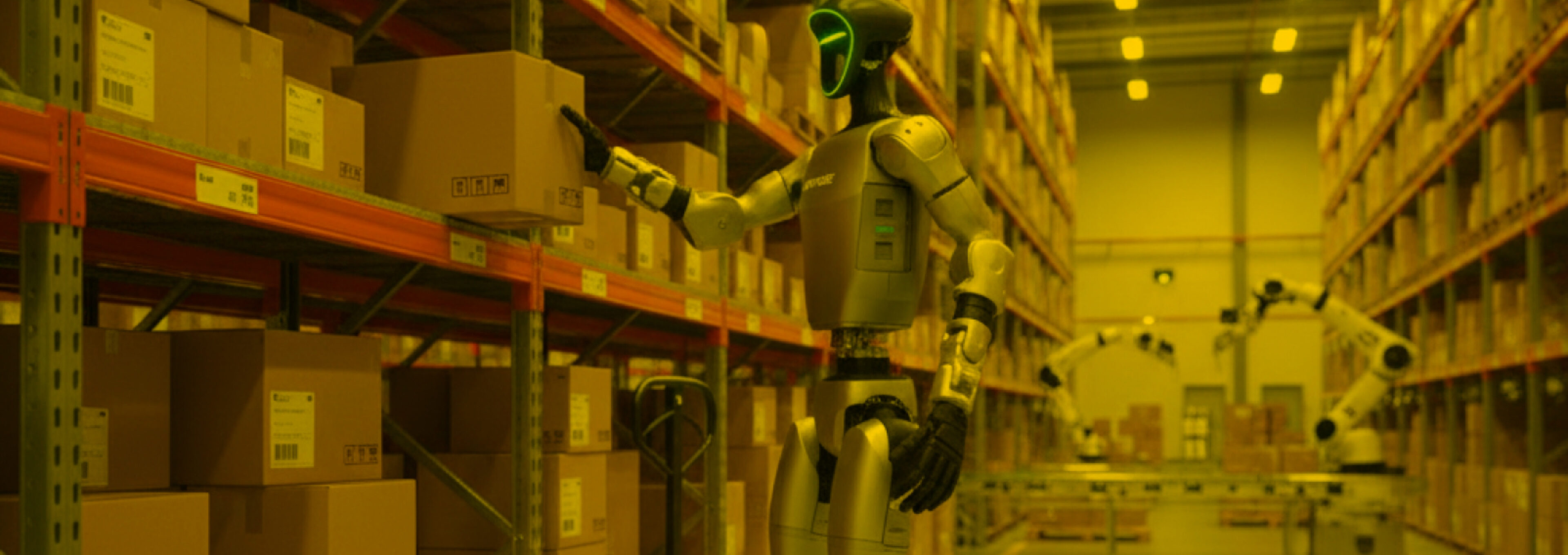
Picture this: a bustling parcel depot. Peak season. Packages are flying off conveyor belts. A tote full of oddly shaped boxes spills onto the floor. A delivery van reverses into a loading bay. And customers keep demanding their packages be re-routed… again.
Now ask yourself: Can a robot handle it?
This is the million-euro question plaguing the courier, express, and parcel (CEP) industry as it wrestles with one of its most tantalizing promises: human-like robots working in chaotic, real-world environments.
The Dream: Humanoids That Move Like Us, Work Like Us
The allure of human-like robots in logistics is simple…they’re built for environments designed for people.
Unlike wheeled robots or fixed robotic arms, humanoids can (theoretically):
- Navigate obstacles
- Switch activities at a moment’s notice
- React in real time to changes or conditions
- Work in tight and unstructured environments
In other words, they could go where autonomous mobile robots (AMRs) and conveyor belts can’t and consolidate the work of various expensive, specialized machines.
Companies like Figure AI and Apptronik are chasing this dream. Tesla even teased its Optimus robot loading boxes. But flashy demos aside, we’re still a long way from humanoids being commonplace in the parcel logistics sector. Humanoid robots remain awkward and slow in unstructured environments, despite major AI gains.
So Why Isn’t the CEP Industry Fully Automated Yet?
- CEP operations are messy
Unlike clean factory floors, CEP environments are full of unpredictable variables: different box sizes, weather conditions, last-mile complexity, and constant human interaction. “Unstructured environments” are the bane of current-gen robotics. As Dachser notes, navigating such chaos is still beyond the current generation of humanoid robots. - Labor is costly…but flexible
Robots might not call in sick, but human workers can adapt, communicate, and improvise. A robot that takes 45 seconds to pick a package (and panics if the package isn’t right-side up) isn’t much help during a peak-season rush. - Cost and integration barriers are sky-high
Retrofitting legacy CEP infrastructure for humanoid robots is expensive. Integrating with old WMS or ERP systems is even worse. And nobody wants to get locked into a single vendor’s robot ecosystem. McKinsey highlights that the biggest gains in logistics automation remain locked behind systems-level redesigns and AI integration many warehouses aren’t prepared for.
There’s still a talent and data gap
Training robots to work in the real world requires tons of high-quality data, advanced simulation environments, and cross-embodiment learning models. Most logistics teams don’t have the infrastructure or expertise to pull this off. Lack of skilled personnel and real-world datasets remains a major blocker.
Possible Solutions to the Robotics Problem
So how are innovators tackling the gap between humanoid robot promise and operational reality?
Here are four approaches making serious progress:
Task Specialization First, Generalization Later
Instead of trying to build robots that can do everything, some companies are shifting the focus to robots that do one thing really well.
Companies like Agility Robotics are deploying robots like Digit to take on narrow, high-value tasks—like moving containers. It’s a practical way to get automation into warehouses without needing a full system overhaul.
PITD’s research agrees with this approach: automating repeatable workflows–with humans stepping in for the exceptions–has led to some promising results. Their belief: it’s about pairing robots with the right job instead of forcing them to be generalists before they’re ready.
Real-World Imitation Learning
Training robots exclusively in simulation may not be enough to handle messy, real environments. Some researchers emphasize reinforcement learning (RL) and imitation learning—where robots learn from demonstrations and real feedback—as critical to advancing adaptability and control.
AI research backs this up: in robotics today, combining reinforcement learning and imitation data is one of the most promising paths toward enabling robots to self‑discover control policies that generalize beyond rigid, pre‑programmed behaviors.
Skild AI, for example, combines human demonstrations with simulation to help robots handle complex, changing environments more effectively. It’s helping close the gap between what robots learn in theory and what they need to do in practice.
Human-in-the-Loop Monitoring
Maybe we’re just not at full autonomy yet—and that’s okay.
In logistics, where environments are fast-moving and unpredictable, human-in-the-loop oversight is often critical. Letting robots hand off tricky decisions to human supervisors keeps operations safer and more reliable while improving outcomes.
Modular Hardware with Plug-and-Play Interfaces
On the hardware side, things are getting more plug-and-play. Modular systems let you swap out limbs, sensors, or wheels depending on the task. And multi-robot coordination is becoming more common, helping distribute workloads and plan more efficient paths.
This kind of flexibility makes it easier to adapt robotics to real-world operations—and evolve them over time without starting from scratch.
In short: Instead of trying to build the perfect humanoid, the industry is beginning to build pragmatic robotic workers—ones that can be deployed incrementally, improved continuously, and integrated into real-world workflows without triggering a full system overhaul.
The Path Forward: Simulate First, Integrate Fast
Instead of trying to brute-force general-purpose humanoids into parcel workflows, the next wave of robotics innovators is taking a different tack.
They’re asking:
What if robots could train for these environments before ever stepping inside them?
What if deployment wasn’t tied to one piece of hardware, but to a flexible software stack?
That’s where Logibot comes in.
While others are focused on building the flashiest humanoid, Logibot is focused on making human-like robots work. Not in the lab. In the warehouse.
Their approach? Flip the script. Start with logistics reality, not robotics theory.
It begins with deep process discovery. Using what they call Logibot.Data, the team dives into your logistics operation and maps it down to the smallest task. We’re talking bin picking, last-meter walks, box handoffs to drivers. Nothing is too minor. They build a full robotization matrix, grading each process by feasibility, risk, and ROI.
Once the groundwork is laid, the magic happens in simulation. Logibot.Simulate creates a digital twin of your environment, then stress-tests multiple robot types against your specific workflows. They model traffic, bottlenecks, charging cycles—even queue collisions between robots and humans. By the end, you know exactly which hardware works, how many you’ll need, and how long they’ll take to pay for themselves.
Then comes the brain. With Logibot.Train, robots are fed a cross-embodiment training stack—think of it as a robotics Rosetta Stone. The system combines pre-trained datasets with real-world mimicry, then fine-tunes the robot’s skills: navigation, manipulation, task-switching, and even interaction preferences. Want it to hand off a parcel a certain way? They can teach that.
But a smart robot is useless if it can’t fit in with the rest of the crew. Logibot.Deploy handles the real-world rollout. That includes integration with your WMS and ERP systems, setting up fallback rules, defining override controls, and managing shift schedules. This isn’t “plug-and-pray”—it’s controlled scaling with live telemetry.
And finally, the feedback loop. Logibot.Watch provides real-time observability across every task and incident. It’s like mission control for your robotic workforce. If something breaks, humans can intervene. If a pattern emerges, the system flags it for retraining. It’s not just monitoring—it’s learning on the job.
The real differentiator? Logibot isn’t married to one robot body. Their platform is hardware-agnostic. That means you’re not locked into a single vendor. Instead, you get the best of all worlds—software, intelligence, and control, all tailored to your CEP use case.
Making Robotic Adoption Make Sense
Logibot represents a shift from hardware-first to integration-first robotics. It’s a much-needed mindset for the logistics sector, where the average warehouse is still closer to 1999 than 2099.
By enabling logistics teams to simulate, test, and tune robots in advance, Logibot de-risks the adoption curve—and turns a futuristic “what if” into a competitive edge.
The result is award-winning robotics deployments that just…work.
Final Thoughts: From Demos to Delivery
The CEP industry doesn’t need more flashy human-like robot demos. It needs solutions that deal with the messiness of real-world operations—without expecting warehouses to become tech labs overnight.
With a software-first, simulation-heavy, logistics-native approach, Logibot is building the bridge between vision and execution. And with plenty of interest from industry heavy-hitters, they’re not just experimenting–they’re deploying.
So the next time you picture a humanoid robot in a postal depot, don’t think sci-fi.
Think Logibot.